
Edition #3: The Price War You're Not Seeing

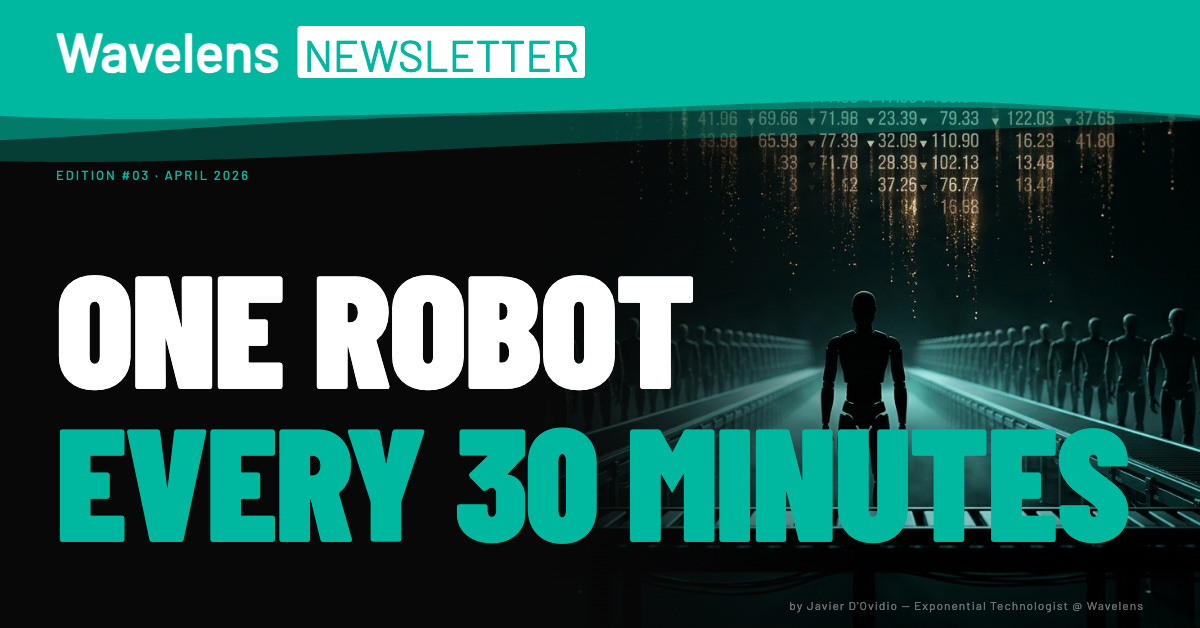
A humanoid robot costs $13,500. A manufacturing worker in the U.S. costs over $150,000 a year. In Germany, over $100,000. In Mexico, around $12,000.
The robot pays for itself in under two months in the U.S. Under three in Germany. Even in Mexico, the math is closing fast, because the robot’s price drops 20 to 30 percent every year.
It’s happening now.
The Signal: The Price War You’re Not Seeing
The public conversation about humanoid robots is still stuck on two questions: “Will they actually work?” and “Will they take our jobs?”
Both questions were already answered on the factory floors of Guangdong.
A Chinese company called Agibot just produced its 10,000th humanoid robot. The number matters less than the curve: it took them two years to build the first 1,000. One more year to reach 5,000. And just three months to go from 5,000 to 10,000. That kind of acceleration in hardware manufacturing is rare.
Agibot isn’t alone. Unitree plans to ship 20,000 units in 2026. UBTECH targets 5,000 this year and 10,000 next year. In Guangdong, the first fully automated humanoid production line opened in March, producing one robot every 30 minutes, with an annual capacity of 10,000 units. China has 160 humanoid manufacturers, backed by 600 suppliers and 10,000 subcontractors. The official plan: between 28,000 and 100,000 humanoids deployed in factories before the end of 2026.
For context: global humanoid shipments in 2025 reached roughly 13,000 units, according to research firm Omdia. 87% came from Chinese companies. Tesla and Figure AI shipped approximately 150 each.
That’s not a gap. It’s a different game.
Now, why should this matter to a CEO who doesn’t manufacture robots?
Because of what it does to prices. The Unitree G1 sells today for $13,500. A U.S. manufacturing worker costs over $150,000 per year with benefits, overhead, and payroll taxes. That means a G1 pays for itself in under two months of labor savings. And UBTECH says manufacturing costs are dropping 20 to 30 percent annually, with 90% of components already made in China. Industry projections: humanoids below $20,000 by 2026-2027, and in the $10,000 to $15,000 range by 2028-2030.
This is exactly what happened with solar panels, lithium batteries, and drones. China didn’t win the technology race in any of those sectors. It won the production race. And the one who produces at scale sets the price. And the one who sets the price sets the adoption curve.
What happens to your cost structure when your competitor’s humanoids work?
You don’t need to buy a humanoid robot. But your competitor might. Or your supplier. Or a new entrant in your industry that doesn’t carry your legacy labor costs. When a humanoid costs $13,500 and pays for itself in two months, the conversation shifts from “does it work?” to “what happens to my operating costs when someone else adopts it?”
That shift is already underway. And most leaders don’t have it on the radar.
The Application: Already on the Factory Floor
This isn’t a pilot phase.
Renault. 350 Calvin-40 humanoids deploying over 18 months at its Douai plant in France. First brownfield deployment at scale in automotive. Target: 30% reduction in production hours per vehicle. The robots handle tire operations and material transport, tasks that are physically demanding and ergonomically challenging for human workers.
BYD, Geely, FAW-Volkswagen, Foxconn, SF Express. All using UBTECH Walker S2 humanoids in production. Material handling, quality inspection, item sorting. Over $150 million in confirmed orders. These aren’t showcase deployments. They’re running 24-hour shifts.
Toyota. Signed a Robot-as-a-Service agreement with Agility Robotics to deploy Digit robots at its RAV4 plant in Canada. The RaaS model means no capital expenditure upfront, just a monthly fee per robot.
Guangdong. China’s first fully automated humanoid production line, opened March 29. 24 digitalized assembly stages, 77 inspection checkpoints, one robot every 30 minutes.
The contrast: Tesla Optimus has no firm commercial sale date. Figure AI robots cost $150,000 to $200,000. Boston Dynamics Atlas: over $300,000. Western companies are building impressive technology. China is building production capacity.
China is winning the production race. And the production race is the one that sets the price.
The Noise: “Humanoid Robots Are Still a Gimmick”
You’ll hear it after every CES demo. After every Tesla PR event. After every viral video of a robot stumbling on stage.
10,000 robots produced by a single company. 87% of global shipments from one country. Active deployments at BYD, Renault, Toyota, Foxconn. A production line in Guangdong that builds one every 30 minutes.
These are not gimmicks. These are industrial tools in real production environments.
The bias works like this: the West watches CES demos and concludes “it’s not ready yet.” China watches its production numbers and concludes “it already started.”
The demo is over. The deployment started.
The Question: What’s Your Cost Exposure?
If a $13,500 humanoid pays for itself in under two months replacing repetitive physical work, which links in your supply chain, your operations, or your competitor’s operations are vulnerable to that math?
If your team can’t identify those links, your competitor probably already has.
Now What?
Map your exposure. Identify which processes in your organization or supply chain involve repetitive physical work, ergonomically demanding tasks, or continuous shift operations. Those are the first candidates for humanoid automation, not necessarily by your decision, but by your competitor’s or supplier’s.
Benchmark the economics. A humanoid at $13,500 with costs dropping 20 to 30 percent per year. Compare that number against the fully loaded cost of equivalent positions in your operation. If the ROI is under six months, the question shifted from “if” to “when.”
Watch the supply chain bifurcation. U.S. lawmakers have proposed the American Security Robotics Act, a federal procurement ban on Chinese humanoid robots citing national security and data privacy. If it passes, the market splits: Chinese prices keep falling while Western prices stay high. Your sourcing strategy needs to account for both scenarios.
And one more uncomfortable question. If these roles get automated, does your organization have a reskilling plan, or just a cost reduction plan?
What I’m Watching
EY deployed agentic AI to 130,000 auditors in global production. The largest documented enterprise deployment of AI agents. 1.4 trillion lines of accounting data processed annually. Built on Microsoft Azure, Foundry and Fabric. Not a pilot. When the Big Four move into production, the corporate market follows. The enterprise confidence threshold just got crossed.
Big Tech is funding nuclear reactors. Meta signed with Oklo, TerraPower and Vistra for 6.6GW. Microsoft is reactivating Three Mile Island for 2027. Amazon: $700M in X-energy. The same sector that created the energy demand is now forced to finance the supply. They’re venture-capitalizing energy infrastructure.
Cloudflare accelerated its post-quantum deadline to 2029. The second major internet infrastructure player (after Google) to move its PQC timeline forward. A convergent signal with the previous edition: the consensus keeps shifting.
This is Wavelens. Emerging tech without the hype. Real signals for strategic decisions.
If this edition helped you see something you weren’t seeing before, forward it to one leader in your network who needs to be in this conversation.
Subscribe at newsletter.wavelens.ai so you don’t miss the next edition. Follow Wavelens on LinkedIn for daily signals on the convergence.
Javier D’Ovidio Wavelens